
This is the 6th in a series of 10 reviews of contemporary weird novels. For an overview of this project, see my first post in the series.
Edgar Cantero is a Spanish writer and cartoonist who’s published novels in Catalan and English. Meddling Kids (2017) was a New York Times best-seller, thanks to positive reviews from mainstream institutions, such as Publisher’s Weekly, USA Today, and NPR. He’s been enjoying some success: Bloody Disgusting, Geeks of Doom, the Financial Times, Indiebound have featured him recently.
As evidence of the “weirding” of contemporary culture, this popularity is notable, especially when we consider that Meddling Kids was published by Doubleday in collaboration with Blumhouse Productions—the company known for lucrative horror films, including Paranormal Activity, Get Out, Sinister and The Purge. Blumhouse is becoming a new kind of lateral entertainment corporation, specializing in weird experiences—alongside films, they produce TV, publish novels, and organize haunted houses, mazes and “scare zones” based on their productions. A multi-media, cross platform company that specializes in popcult weirdness. They have captured the market in B movie horror for all the best reasons.
From the perspective of the weird literary tradition (as though one could see with the eyes of the thing), Meddling Kids is a nodal point between horror (a mainstream subgenre of the weird that emphasizes supernatural monsters, from Lovecraft and William Hope Hodgson to King and Rice) and several more contemporary slash fanfic elements. As reported on Wikipedia, Book Riot considered Cantero’s novel to be one of the best queer books of the year. (Book Riot’s interview with Cantero is a good place to learn a little more about him.) The novel’s weirdness resonates with several of its queer elements. Very basically (and Cantero’s devils are all in the details), this is fan fiction that explores a lesbian romance between two hetero cartoon figures, one of whom is often our protagonist. The genre-based cast features these competent and familiar final girls, accompanied by their Weimaraner and a dopey former classmate dude. Their exploits are rendered in a scintillatingly campy prose style. Everything is drawn with a sharp wit, if not always with a queer eye. Like George Saunders’ Lincoln in the Bardo (reviewed in a previous post), Cantero is a weird stylist. But while Saunders’ prose draws on historical and contemporary speech acts—the lingua franca of U.S. subjectivity—Cantero’s is visual and media-oriented: he “translates” visuals–in this case cartoons–into a novelistic framework, queering them along the way. It’s plot is a genre mashup, part teen romance, part Lovecraftian horror, part TV fan fiction. I won’t try to enumerate the ways in which Cantero’s novel recalls the weird tales of Hoffmann (particularly The Life and Opinions of Tomcat Murr) or Poe (particularly Pym), but my analysis reflects my appreciation of the book’s capacity for creating a weird world by combining semi-ironical allusions to popular texts. Meddling Kids belongs to the genre of weird literature, even though it’s too silly to be considered a horror novel and too tongue-in-cheek to be regarded favorably by the contemporary Lovecraftians, whose ontology is inflected by “dire realism”—a dour posthumanism that expresses an eco-nihilism in which the worst possible case is the most realistic. (See for example: Omidsalar, Alejandro. (2018). “Posthumanism and Un-Endings: How Ligotti Deranges Lovecraft’s Cosmic Horror” in The Journal of Popular Culture.) The popular in Meddling Kids manifests as a gleeful optimism that grows out of Cantero’s love of low-brow culture. It enjoys the same fast-paced superficiality, the genre leaping, explored in my previous post, on The Drive-Thu Crematorium, but with a much sunnier disposition, a playfulness in place of Bassoff’s pulp abjection.
SPOILER ALERT: There is only one spoiler for this novel, and it occurs before we get to page one. Between the title page and the first page of the prose narrative, we get the reproduction of an imaginary newspaper: The Pennaquick Telegraph of August 29th, 1977. A headline fills the page: “TEEN SLEUTHS UNMASK SLEEPY LAKE MONSTER.” Below the headline is an image of the sleuths, their quarry, and the arresting officer. One of the sleuths is a dog. If you existed within U.S. culture’s broad televisual penumbra since the 1970s, you’ve begun to recognize the subgenre. It was dominated by those Sunday morning cartoon teen sleuths known by the name of their impossible protagonist, Scooby Doo. According to Cantero, the original model was Enid Blyton’s Famous Five franchise, but the published text of Meddling Kids draws closely on Scooby Doo episodes. If you can’t stand the animated show originally called Scooby Doo, Where Are You? that’s all you need to know. Stop now, because the novel makes few (albeit thoughtful) deviations from the cartoon. If you’re still interested, you’ll be pleased to know that this novelization is so dedicated to “translating” the visual into the verbal that it achieves a weirdness that at least equals the pleasurable goofiness of the cartoons.
Hyperreality and Horror Narratives
Meddling Kids must be one of the most “postmodern” novels ever written—at least according to the hallmarks of postmodernism identified in the 1980s and 90s (by Jean Baudrillard and Fredric Jameson, for example). The plot is a “procession of simulacra.” By modernist standards, it has no reality principle. The depth model of subjectivity and the logic of Naturalism (according to which sensation is shaped by forces beyond control or understanding) have been abandoned.Like Saunders’ Lincoln in the Bardo, it’s critical and consumer success suggests a new normal in the publishing world—a tolerance for pastiche that used to be exceptional has become the new normal.
According to Jean Baudrillard, writing in the early 1980s, our world has become a “system of objects” dominated by “models of a real without origin.” (Simulacra and Simulation, trans. Sheila Faria Glaser, p. 1). The map now determines the territory; “No more mirror of being and appearances, of the real and its concept. . . The real is produced from . . . memory banks. . . It no longer needs to be rational, because it no longer measures itself against either an ideal or a negative instance. It is no longer anything but operational. . . It is a hyperreal, produced from a radiating synthesis of combinatory models in a hyperspace without atmosphere” (p. 2). Baudrillard fails to predict the return of the real in the form of global crisis (be it global warming or pandemic), but his analysis of popular culture predicts 21st century cultural phenomena from reality TV to Trump’s presidency with remarkable clarity.
The unreality Baudrillard describes—one in which “simulation threatens the difference between the ‘true’ and the ‘false,’ the ‘real’ and the ‘imaginary’”—has troubled writers of weird tales since the emergence of a modern sensibility in the early 1800s. But Baudrillard argues that in the 20th century (never mind the 21st) the “ground” of reality, be it idealism or materialism, has eroded. In hyperreality, the imagination, in order to remain apart from a consumer culture in sheen replaces substance, retreats into a world of hypercontrolled cuteness. This passage from Simulacra and Simulation resonates with several elements of Cantero’s novel:
The imaginary of Disneyland is neither true nor false, it is a deterrence machine set up in order to rejuvenate the fiction of the real in the opposite camp. Whence the debility of this imaginary, its infantile degeneration. This world wants to be childish in order to make us believe that the adults are elsewhere, in the ‘real’ world, and to conceal the fact that true childishness is everywhere—that it is that of the adults themselves who come here to at the child in order to foster illusions as to their real childishness. (p. 13)
This sensibility resonates with Martin Scorsese’s recent comments about superhero movies resembling theme park rides. In a cartoon world, the shock is continual and unmitigated because it doesn’t matter—the ride always comes to the same end. Thus the Marvel universe, in which everything has shock but nothing has value. Scorcese mourns a cinematic realism he resuscitated in the 1960s (at the expense of working class and white ethnic stereotypes, not to mention the Manhattan of the 1960s).
Horror narratives have continued to grapple with the “adult” side of hyperreality in various ways. Two approaches suggest themselves. The first is an object-oriented or creature-based approach to the weird, the second is subject-oriented and metafictional. The difference between these approaches involves where and how they engage with the terrible pleasures of the simulacra.
In the B-movie entitled “Horror of the Simulacra,” the monster replicates/infects its victims, so that its prey (or protagonists) can’t tell who is what. This is the premise of many brilliant horror films, such as The Thing (1951; 1982) or Invasion of the Body Snatchers (1956; 1978). In these movies, the strange thing masquerades as human before it manifests as the monster (an animated plant in both cases). John Carpenter’s The Thing stands in clear opposition to the other alien monster movie of 1982, E. T. The Extra-Terrestrial, which brought a new degree of childish cuteness into national culture. But in keeping with Baudrillard’s premise, we might say that narratives such as Carpenter’s are threatened by E.T.—they succumb to a form of enjoyment that disregards the attempts at cinematic realism in order to enjoy generic repetitions. Indeed, “Horror of the Simulacra,” as an imaginary title, dispels the uncanny suspense. Such a film, like many a Hammer production, would be appreciated as the object of playful derision, not fear. I use Carpenter as an example because he recognized this problem—his solution was to embrace campiness, resulting in Big Trouble in Little China (1986) and They Live (1988). These movies “reply” to the commercial failure of The Thing by doubling down on B-movie tropes. They partially absorb the simulacra by camping it up. Like the Scooby Doo TV series, Meddling Kids favors this approach. It relies upon B-movie monsters to establish a generic plot. We know the formula. It then ornaments the generic structure, with as much flavor and flair as possible.
I want to complete my weird analogy before proceeding. The B-movie entitled “The Simulacra of Horror” is quite different; it represents a much more radical approach to the threat of the simulacra monster. This movie is either a documentary about special effects in horror films, or it’s a post-Hitchcockian psychological thriller, along the lines of Antonioni’s Blowup (1966), Pakula’s The Parallax View (1974) or De Palma’s Blow Out (1981) and Body Double (1984). In these films, the veracity of the image is doubted, and this doubt becomes the basis of the suspenseful (but not supernatural) plot. The simulacra is contained by the image; our inability to trust the cinematic realism—we don’t know if what we are seeing is what the protagonist is seeing–generates the horror. The horrible thing is the film itself. In these plots, an “adult” reality remains possible because the truth content of visual signification is the source of disorientation. Realism overcomes the comedy of generic repetitions. The plot, driven by the remediation of realism, tends to be original; there is little space in the presentation for a generic formula. The ultimate achievement in this direction is Carax’s Holy Motors (2012); this is not a horror movie, but it is profoundly weird. It includes a supernatural monster but mitigates its impossibility by presenting a narrative in which subjectivity is no longer coterminous with the body of the protagonist.
This is not the approach taken by Cantero. He give us a fantastical narrative within a thoroughly mainstream novel. (Just as the TV franchise to which he pays homage was carefully planned for a market demographic.) The same elements (impossible creatures, unreliable representations) are satirically entangled and disentangled in the comedic plots of Scooby Doo episodes. It’s fun, like a theme park ride. Its limited pleasures consist of taking apart and putting together generic tropes. The whole thing is driven by a wry pop-cult campiness, fueled by an endless stream of allusions and a comic book style. Cantero’s novel marks a new level in the ascension of fan fiction up the ladder of literary respectability. It is more literary than novelizations of movies, but more dedicated to pop-culture than even Sethe Grahame-Smith’s mashups, Pride and Prejudice and Zombies (2009) or Abraham Lincoln, Vampire Hunter (2010). I guess you could read it without knowing the TV show, but as someone who does remember Scooby-Doo, I’d say that the novel’s reconstruction of the TV characters, plots, and scenes is at least 60% of the (already attenuated) fun.
Scooby-Doo, What Are You?
Scooby-Doo, Where Are You? was written by Joe Ruby and Ken Spears for Hanna-Barbara Productions; it aired in 1969, making a vigorous nod to popular versions of the counterculture. It played on CBS until 1976, then on ABC until 1985. Warner Brothers made numerous spinoffs, including TV specials and feature-length films. The show’s premise drew on already popular teen sleuth narratives—The Hardy Boys and Nancy Drew franchises. But the show’s “meddling kids” were a team of four, plus the dog. The titular hound embodies their collective id, but also serves as the transitional object for one of the crew’s members, Shaggy. This brilliantly designed character is essential to the show’s libidinal economy, which is pitched at the precise angle where the pseudo realism of teen adventure romances meets the Dr. Seuss like nonsense of cartoons. Allow me to explain, because the best part of Cantero’s novel is the way he translates this part of the original TV show into a new version of novelistic realism.

The Scooby Doo universe combines a strand of teenage sentimental realism with the metaphysical surrealism developed by Chuck Jones in Warner Brothers cartoons. By “teenage sentimental realism,” I mean a subtle but consistent atmosphere of heterosexual and homosocial desire, combined with a persistent attitude of meaningless irony, bolstered by an underlying faith in science. The irony is expressed by all the characters except Scooby and sometimes by the visual style. The realism is a narrative conceit borrowed from the Hardy Boys and Nancy Drew (not to mention earlier generations of teenage sleuths), which allows our adventurers to accept the possibility of supernatural entities while always unmasking them as real-world criminals. By “metaphysical surrealism” I mean the conceit used by cartoonists like Jones to establish weird parameters for modernist cartoon realism. These parameters combine extreme physical malleability with indestructibility. Scooby Doo’s father is Wile E. Coyote, who could run in the air, accordion on impact, or get stretched and squashed without harm. He might limp for a few panels, or be all squashed up and dizzy, but a minute later he was ready to go. The show’s visual style combines this with a teen-sleuth realism. Most of the time, the extreme malleability happens to Scooby, and sometimes to Shaggy, but it occurs less frequently with the other characters. Like Scooby himself, these parameters are rubbery.

The success of the franchise may be attributed to the elegant way it allows these elements to combine. Fred and Daphne are a good-looking couple, your basic teen idols, like if the beefier Hardy boy was adventuring with Nancy. Velma and Shaggy are valuable if decidedly less hip sidekicks, like if Nancy’s friend George was hanging out with a scrawny version of the Hardy’s chum Chet.
In mimicry of 1970s teenage vagaries, no one is or isn’t a couple, But Velma and Shaggy are less of an item than Fred and Daphne. They haven’t made it because Shaggy still clings to his pre-Oedipal identity, which is embodied in a surreal dog.
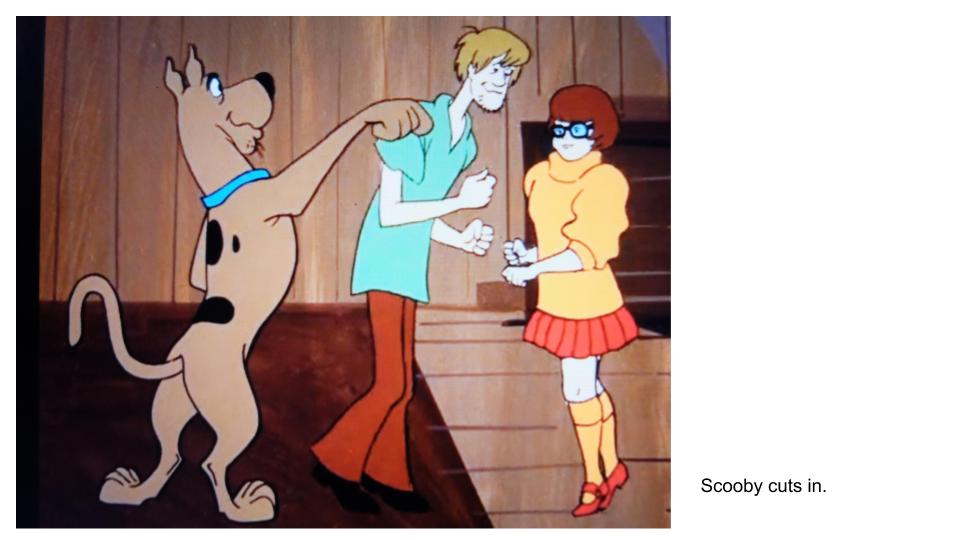
Scooby’s cousin in the magical dragon that Pete discovers; his grandson is the teddy bear that comes to life for Mark Wahlberg in the Ted franchise. Fortunately for everyone, Velma sublimates her unreciprocated desire into rationality, which is why she’s always more skeptical of the supernatural than the others. The elegance I mentioned above emerges in the show’s ability to realize this psycho-social drama in a visual style that allows the dog (and those in its proximity) to undergo all manner of transformation without ill effects. Scooby can become a motorcycle, for example, or get swung like a baseball bat.
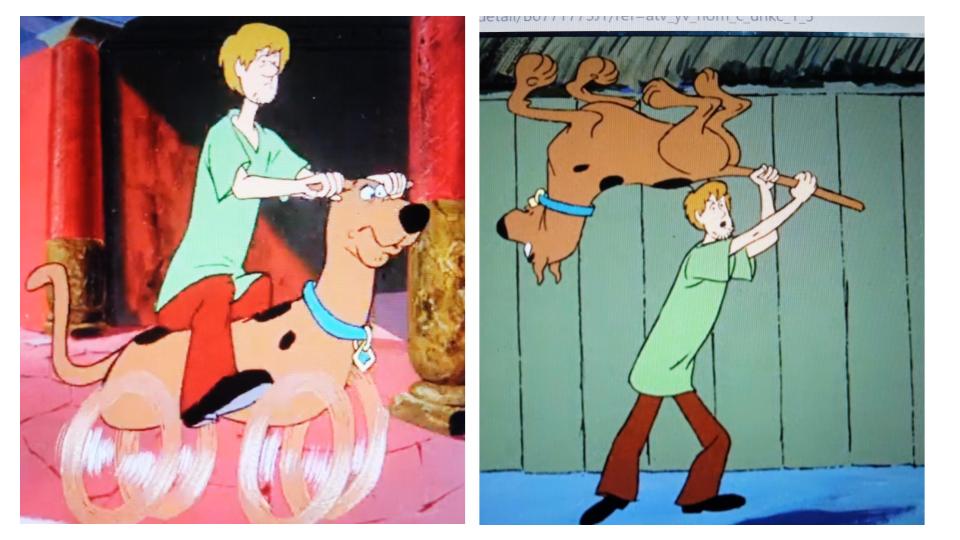
Scooby’s infinite malleability and ultimate invincibility make him a figure for the id, but he manifests pure desire in the narrative as well, such as in his endless hunger, his intense but short-lived episodes of fear, and his endless capacity to forgive and forget.

The Lovecraftians will damn me for comparing Scooby Doo to a Shoggoth (not to mention an Ancient Old One), but the formula is the same. In this case, the impossible object is what Todorov would call a “miracle”—the repressed thing figured as a character in the narrative without any doubt on the reader’s part. In Scooby Doo TV episodes, the ghoul is never a ghoul, the ghost is never a ghost, the phantom always turns out to be an ordinary thief. The impossible thing lies on the other side of the narrative—it’s one of the good guys (like E.T.).
Meddling Kids, Where Are You?
Cantero rewrites the relations between our teen sleuths without giving up the basic libidinal components; he rewrites the realism to include a supernatural entity out of Lovecraft. He establishes fictional realism, while maintaining stylistic surrealism. Like everything in the mass culture simulacra, the results are thrilling minute by minute but painfully meaningless in the long haul. Much like the bizarro fiction reviewed in my previous post, Meddling Kids deliberately moves too quickly to establish meaningful realism, but whereas Bizarro fiction is satirical and embraces the abject, Cantero’s novel is more like an ode to consumer culture; it embraces the cute and the cool.
A novelistic realism is partially established by making our teen sleuths into thirty-somethings who have succumbed to ordinary loss and desire. Their names and personal histories have been changed, but the structure of social relations established in the TV show is maintained. Their characters are realized through free indirect discourse. In Meddling Kids, Scooby is played by a non-cartoonish but focalized dog named Tim, while Daphne is played by Kerri and Velma is played by Andy. In the opening chapter, Andy attempts to “put the band back together” (46); they’ve drifted apart after that last adventure and the death of Peter, who plays the role of Fred and whose ghost haunts Nate, who is Shaggy’s substitute. A lesbian subplot is established by revealing Andy’s crush on the hetero Kerri. Several passages from an early scene between Andy, Kerri, and Tim demonstrates the narrative style that remains (tediously) consistent throughout the novel:
     “We are scared!” Andy countered. “We’ve been scared ever since! We never went back to Blyton Hills after that. . . Why aren’t we back in that house solving the real mystery?”
     “Because we grew up!”
     It went downhill from there, Tim noticed, watching the girls on the bed . . . a moody Mom and Dad are fighting look on his Byronian face.
     Kerri caught her breath, tired and sad. “We grew up, Andy. We grew apart. That’s life. . . We can’t spend our whole lives in Blyton Hills, chasing sheep smugglers and lake creatures.” . . .
     She lay down and switched the light off. The coils in the toaster glinted yellow in the dark, a poor but well-intended impersonation of a fireplace.
     Andy met Tim’s eyes, the dog’s profile outlined in the warm glow. They held a silent exchange for a minute or two, until Tim deemed it courteous to lay his head down, cose his eyes, and pretend to sleep.
     Kerri murmured in the brown dark, “Can you please take your arm off me? I feel smothered.”
     Andy’s right hand radioed a message: We’ve been spotted. And it fell back. (30-1)
The drama—the friends must decide if being grown up means they should ignore a past that continues to haunt them—and the subtext (Andy’s crush on Kerri) are about fifty percent of the novel’s thematic components (the other half is Peter’s ghost and the Lovecraftian horror). The dog’s mute eloquence is consistently part of the plot, although his role is far less than Scooby’s in the cartoon, due to the pretense of realism. In the above passage, the “coils in the toaster” are actually strands of Kerri’s orange hair, which actually glows, causing the “brown dark” by which Andy and Tim regard each other. This is a magical component—a cartoonish aspect—which is woven into the narrative through a focalization on Andy. We are not sure if Kerri’s hair actually glows, or if it does so only for Andy. Similarly, when Andy’s arm communicates with the rest of her soma as though it were on a secret mission of its own, the narrative style is precisely geared to keep the phenomenon halfway between free indirect discourse (i.e., Andy’s imagination) and a cartoon reality in which bodies perform these supplemental actions on a regular basis.
While ever present, the cartoonish qualities of this universe expand during the numerous action sequences. A early one occurs when Tim, Andy, and Kerri bust Nate out of Arkham asylum, in a scene more reminiscent of The A-Team than Lovecraft or Batman. Tim trots into the asylum, past the various nurses and guards, carrying a rope with a large hook on one end. The rope is tied around Nate and “In the next heartbeat, Nate was quite literally fired off his armchair and through the human barricade of wards and nurses, scattering them like rubber bowling pins. By the time his backside touched the linoleum again he was already halfway down the corridor, zigzagging off the walls like a pinball, zooming toward the stairwell door . . . He touched about six steps in three floors. With his head” (51). This is something you’d find the Scooby Doo cartoons, with either Scooby or Shaggy undergoing the impossible punishment unscathed.
I’m struck by how much this top-selling young adult novel resembles Saunders’ award-winning Lincoln in the Bardo, discussed in an earlier post. Both books are dedicated to a comical, surrealistic narrative which is achieved through a neo-Romantic prose style. They are hyper-eloquent and dedicated to matching melancholia with silliness. Shortly after the above scene, Meddling Kids breaks into script format, which lends even more resemblance to Saunders’ genre-busting presentation of his story through epigrammatic speeches. In Cantero’s world, the silliness can be metafictional:
     NATE: I once spent five weeks digging a tunnel out of a clinic where I’d been admitted for two weeks.
     ANDY: (After rereading the lines above.) Why didn’t you walk out after the two weeks? (57)
The point here is to reproduce the goofy cartoon gags of the TV show by finding their literary analogues. To this end, Cantero keeps as busy as any Warner Bros. cartoonist, inventing hundreds if not thousands of such gags. Once these become customary, like a rhythm section, he introduces scenes from other genres, particularly pulp horror. The team discover passages from the Necronomicon and soon enough must confront lake monsters that are not jewel thieves in disguise:
It took some time for the human brain to comprehend. A few things could be established without ambiguity. It stood, or slouched, on two legs. And the upper limbs, overjointed as they were, might have been called arms. The limbs in between were harder to classify. . . And it had a face of a sort. Most of its head, wobbling sickly at the end of a twisty-tendoned neck, was blank, all smooth gray salamander skin; but a single feature, a deep barbwire impression from absent ear to absent ear, smeared with black blood, seemed to mark where the mouth was supposed to be.
If you are familiar with the countless versions of this almost unthinkable monster that circulate in pulp stories, comics, video games, TV shows, etc., you’ll appreciate the details of Cantero’s imagery. The balance between a Lovecraftian monster—one that punctures the characters’ reality by entering the text as a thing that is nearly impossible to describe—and a cute cartoonish satire of the same thing (the barbed-wire mouth between absent ears) is thrillingly precise. And thankfully, he knows that this mashup between the pseudo realism of pulp adventure stories and their cartoonish double makes for a delicious camp sensibility, which is leveraged time and again as the generic plot unfolds. It’s good antic comedy when Kerri and Andy argue over the effectiveness of various cartoon ploys when facing “real-world” necromancers:
     ANDY: Right. What if we lure him out and set a trap like last time? We build a Lake Creature Phony Express!
     KERRI: You expect a hundred-fifty-year-old necromancer to pull open a fake door in his own house, roll down two flights of stairs on a serving cart, and land in a fishing net? Also, no cart and no net.
     ANDY: True. (Thinks, then to Tim.) Feel free to jump in any time.
     TIM: (Tilts his head, resenting the pressure.)
This is a typical sequence from a Scooby Doo cartoon, with the dog’s expression providing the gag. This sequence is rendered with a post-Gothic literary realism—it obeys the laws of the known universe and the rules of decorum you might expect from Dickens, for example. Within this reality, the characters are astonished to discover monsters from a nearby universe—the world of pulp novels. Cantero juggles the generic expectations well. The plot has numerous, if rather predictable, twists and turns, like any good theme park ride. Like so many pop cult franchises these days, this is a knowingly generic form of weirdness. It’s weirdness emanates from a campy antic stylishness that allows Cantero to braid together genres with a wink. He leaves everybody more or less holding hands at the end, while unmasking various real-world and supernatural culprits. Literary realism is merely a style; one filter through which to render the characters in a fairy tale set in the magical forest of morning cartoons.
 matthiasregan.org